In the shadow of the Pak-Afghan International border, a simmering conflict has erupted into what Pakistan’s Defense Minister Khawaja Asif aptly termed an “open war.” The March 16, 2026, airstrikes by the Pakistan Air Force on military targets in Kabul and Nangarhar province were not acts of aggression but a measured response to the Afghan regime’s drone attacks and blatant sponsorship of terrorism. For too long, Islamabad has endured the duplicity of a regime that preaches sovereignty while harboring the FAK (Fitna-al-Khawarij), a terrorist group responsible for countless Pakistani deaths. It’s time to call out the regime’s farce: a government unfit for international recognition, one that weaponizes misinformation to mask its failures.
The roots of this crisis trace back to the regime’s seizure of power in 2021, but the escalation in 2025-2026 exposes their true colors. Despite repeated diplomatic overtures from Pakistan, including mediation attempts by China, the regime in Kabul has allowed FAK terrorists to establish safe havens in Afghan provinces like Nangarhar, Paktika, and Khost. Pakistani intelligence has provided conclusive evidence that FAK leaders orchestrate attacks from these bases, flouting international counter-terrorism norms. The February 6 suicide bombing at an Islamabad Shia mosque, martyring 31 innocents, and the February 16 assault on a Bajaur checkpoint, claiming 11 security personnel, were direct outcomes of this complicity. FAK claimed responsibility, yet the regime denies any involvement, a laughable pretense that fools no one.
International reports have repeatedly confirmed these safe havens, validating Pakistan’s long-standing position. The United Nations Security Council’s Analytical Support and Sanctions Monitoring Team, in its 2025 annual report (S/2025/796) and the 37th report (S/2026/44) issued in early 2026, described the regime as maintaining a “permissive environment” for terrorist groups, notably FAK. These UN documents detail terrorist training camps, extremist religious schools, and safe houses linked to lethal FAK attacks in Pakistan. The reports estimate around 6,000 FAK terrorists harbored in Afghanistan, receiving substantial logistical, operational, and tactical support from the regime, including new training centers in Kunar, Nangarhar, Khost, and Paktika provinces. The UN explicitly rejected the regime’s claims of “no terrorist groups operating from its territory” as “not credible,” warning that such sanctuaries pose a serious threat to regional stability and enable over 600 FAK attacks in Pakistan in 2025 alone. These multilateral findings underscore that Afghanistan under this regime has become a sanctuary for terrorists targeting neighbors, with the regime facilitating rather than curbing their activities.
Pakistan’s patience, as Minister Khawaja Asif stated, has run out. Operation Ghazab Lil Haq, launched in late February, represents a shift from restraint to resolve. The March 16 strikes exemplified this: precision operations targeting ammunition depots, technical equipment storage, and tunnels used by the regime and FAK terrorists to plot against Pakistani civilians. Satellite imagery and official briefings confirm hits on military installations near Ahmad Shah Baba International Airport in Kandahar and other strategic sites. Information Minister Attaullah Tarar reported over 415 regime soldiers killed in these and prior actions, a testament to the regime’s vulnerability when confronted.
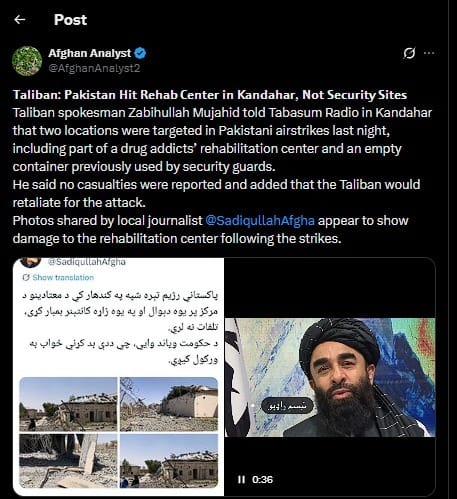
Yet, in a desperate bid to deflect blame, the regime resorted to grotesque propaganda. A clear pattern of inconsistency emerges when examining their statements on strikes involving drug rehabilitation facilities. On March 15, 2026, following Pakistani airstrikes in Kandahar province, Taliban spokesman Zabihullah Mujahid explicitly stated that the attacks targeted part of a drug rehabilitation center (along with an empty/old container previously used as a military post or security guard site). He emphasized that the locations were largely empty or unused at the time, describing one as an “empty container” and the rehab site as suffering only slight/material damage, with no casualties reported at all. This downplaying was consistent across multiple sources, including OmidRadio, Tawazon Media, Liveuamap, Amu TV, Pajhwok, and The Guardian, where Mujahid confirmed zero deaths while warning of a future response and accusing Pakistan of aggression.
Shortly thereafter, India publicly condemned Pakistan’s airstrikes in Afghanistan as an “act of aggression,” a “cowardly, blatant assault,” and a violation during Ramadan, highlighting alleged civilian deaths and destruction. Indian outlets and statements amplified anti-Pakistan narratives, often platforming or echoing Afghan claims of disproportionate force and humanitarian violations without full independent verification.
Following this external condemnation and amid escalating exchanges, the regime dramatically reversed its narrative on a subsequent (or related) strike in Kabul. Deputy spokesman Hamdullah Fitrat and Zabihullah Mujahid described an airstrike on the Omid Addiction Treatment Hospital (a drug rehab facility) as a “crime against humanity,” claiming it destroyed large sections of a 2,000-bed facility, killing at least 400 people (mostly patients/addicts) and injuring around 250. Mujahid posted condemnations on X, accusing Pakistan of deliberately targeting civilian sites/hospitals, with figures amplified in Indian media. Reports on the Kabul facility’s capacity converge on approximately 2,000 beds in recent coverage, though earlier Afghan rehab facilities have varied (e.g., historical 300-bed or 5,000-bed reports for different sites), explaining some discrepancies in reporting across locations and incidents.
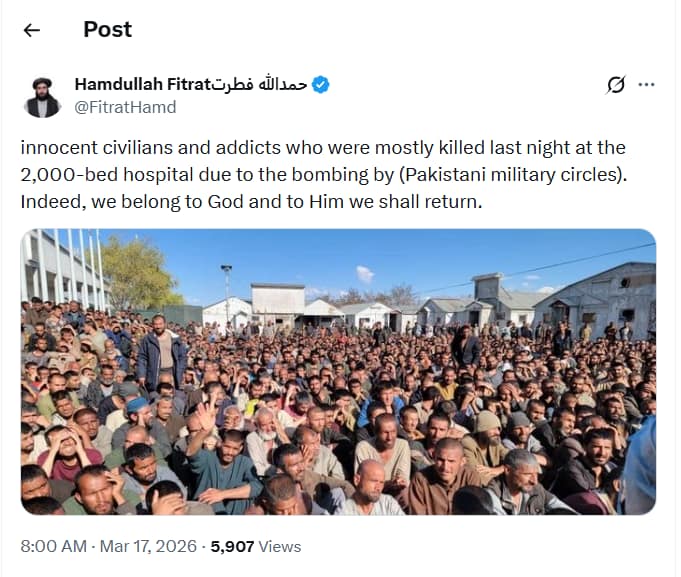
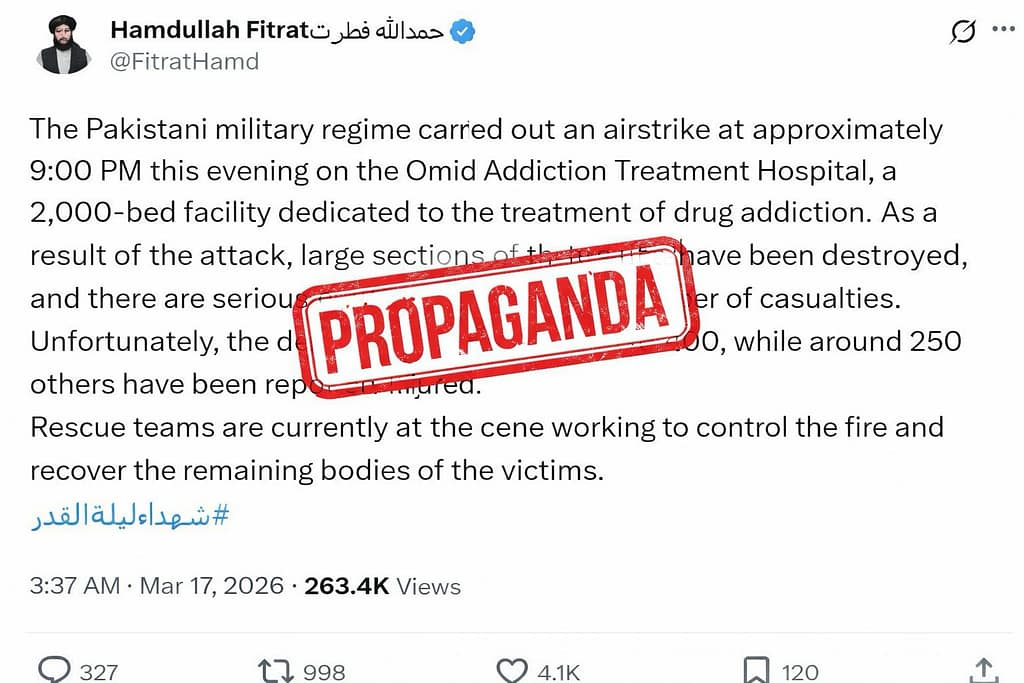
This sequence logically reveals opportunistic narrative shifting that severely undermines the regime’s credibility: When an initial strike (Kandahar, March 15) had minimal verifiable impact, per their own admission of an empty site and with no casualties, they downplayed it to avoid appearing weak or to frame Pakistan as an ineffective aggressor. Once India and others condemned Pakistan broadly, providing external validation and international pressure, they pivoted to inflate a later incident into a massive civilian massacre. This maximizes sympathy, justifies retaliation rhetoric, and leverages outrage (especially during Ramadan) to portray Pakistan as the aggressor while deflecting from allegations of harboring groups like FAK. The stark flip-flop, from “no casualties, empty place” to “400+ dead in a huge 2,000-bed hospital”, lacks consistent evidence, with Pakistan denying civilian targets and insisting on military/terrorist infrastructure only. Such inconsistencies, combined with prior examples of misinformation (e.g., AI-generated or fabricated images), suggest statements are tailored for political gain rather than factual accuracy.
This mirrors earlier tactics, such as deputy spokesman Hamdullah Fitrat posting an AI-generated image of a “destroyed house” in Kandahar, exposed by Pakistan’s Ministry of Information as fabricated misinformation designed to portray Pakistan as a civilian-targeting aggressor. Such tactics, amplified by sympathetic coverage on Indian outlets, erode the regime’s already tenuous credibility, especially as they lobby for global legitimacy amid their oppressive rule over Afghan women and minorities. India’s role in platforming these unverified claims further highlights how certain actors exploit the situation to push anti-Pakistan agendas, ignoring the root cause: Kabul’s sponsorship of cross-border terrorism.
The human toll on Pakistan cannot be ignored. Regime-enabled FAK terrorist attacks have displaced thousands, closed over 100 schools in border regions, and inflicted civilian casualties through mortar shelling, as seen in the Bajaur incident where four brothers perished in their home. UN High Commissioner Volker Türk noted the “misery on misery” piled on both sides, but the root cause is Kabul’s refusal to dismantle terrorist networks. While Afghanistan reports civilian deaths from clashes, these are often exaggerated or self-inflicted amid regime retaliation. Pakistan, conversely, prioritizes precision to minimize collateral, as evidenced by ISPR statements emphasizing intelligence-driven targeting.
President Asif Ali Zardari warned that regime drone strikes on Pakistani civilians crossed a “red line,” bringing “grave consequences.” This isn’t warmongering; it’s self-defense under international law, akin to any nation’s right to neutralize threats. The regime’s “appropriate response” rhetoric, echoed by spokesmen like Zabihullah Mujahid, rings hollow when it shelters groups like FAK, ETIAM and ISIS-K, perpetuating regional instability.
The international community must awaken to this reality. Bodies like the UN Security Council, which recently discussed the conflict, should pressure the regime to expel FAK terrorists and cease cross-border incursions. Aid to Afghanistan should be conditioned on verifiable counter-terrorism measures, not funneled to a regime that uses it to bolster terrorists. Pakistan has shown restraint for years, engaging in talks despite provocations. But with over 331 regime fighters killed in late February alone, the message is clear: Harbor terrorists, and face the consequences.
In this open war, Pakistan stands for stability, not subjugation. The Afghan regime must choose: Dismantle terrorist networks or remain isolated pariahs. Anything less invites further peril, not just for Pakistan, but for a region weary of their treachery and the misinformation campaigns propped up by biased external narratives. The strikes of March 16 were a wake-up call; ignoring it would be folly.

Nimra Khalil is a Pakistan-based geopolitical analyst and opinion writer specializing in international relations, security strategy, and great power competition in a multipolar world, with a focus on South Asia and the Asia-Pacific.