Red Sea to Hindu Kush: Inside the Pakistan–Saudi Bid for Strategic Autonomy
As Houthi missiles light up the Red Sea and Afghanistan’s fragile peace fractures anew, two old allies are quietly recalibrating their security playbook. Pakistan and Saudi Arabia bound by decades of military cooperation and financial interdependence are now sketching the outlines of a new strategic axis. It’s not just about Iran, nor about symbolism. It’s about the slow, deliberate birth of a self-reliant security order in the Muslim world. This cooperation reflects Pakistan Saudi strategic autonomy emerging amid shifting regional security dynamics.
The Unseen Pivot
For a long period of time, Islamabad and Riyadh operated within the orbit of external powers like Washington during the Cold War. In 21st century it is in Beijing and Gulf monarchies under US protection. Even though it’s not a bad thing, the arrangement was pretty good ad meet their transactional needs like arms for influence and oil for loyalty.
But by 2025, both capitals appear to have reached the same conclusion: the world’s “stabilizers” have lost interest. The United States has reduced its military footprint in the Middle East; China’s approach remains strictly economic. In this vacuum, regional actors are quietly improvising.
A senior Pakistani defense official told this writer in Islamabad:
“The world is reverting to bloc politics without any moderators. For Pakistan and Saudi Arabia, the message is simple, if we don’t secure our own peripheries, no one else will.”
In early 2025, the two states revived dormant joint military coordination forums, reactivated defense production talks, and agreed on “rapid maritime interoperability.” The shift is more than bureaucratic. It signals intent: to build capability within the region rather than dependence beyond it.
Beneath the Surface: Political and Economic Drivers
Pakistan’s Side of the Equation
Pakistan’s return to strategic centrality is driven by necessity as much as ambition. With the IMF program constraining defense spending, the country’s security planners are repackaging military capability as a regional service export naval cooperation, counterterror expertise, and defense manufacturing partnerships.
A senior official at Pakistan’s Ministry of Defense Production described the approach as “geo-economics through security.”
“We are not just defending borders anymore; we are monetizing security capacity. That’s the new doctrine.”
Pakistan’s regional stabilization vision aligns with it but it needs to evolve. Pakistan seeks to replace reactive counterterrorism through structured partnerships present in the Gulf, East Africa and Central Asia.
Saudi Arabia’s Strategic Recalibration
For Riyadh, the logic is similarly realistic. As Vision 2030 transforms the Saudi economy, stability of the Red Sea has become existential. Nearly 12% of global trade flows through it, much of it carrying Saudi oil and refined products.
The United States’ reluctance to directly confront Houthi disruptions, and the limited scope of European naval engagement, have left Saudi policymakers considering new layers of maritime cooperation. Pakistani officers, already embedded in advisory roles within the Saudi Ministry of Defense, have become part of that quiet redesign.
A Gulf-based defense analyst noted:
“Pakistan offers Saudi Arabia what no Western power can military partnership without political conditionality.”
The Red Sea Test Case
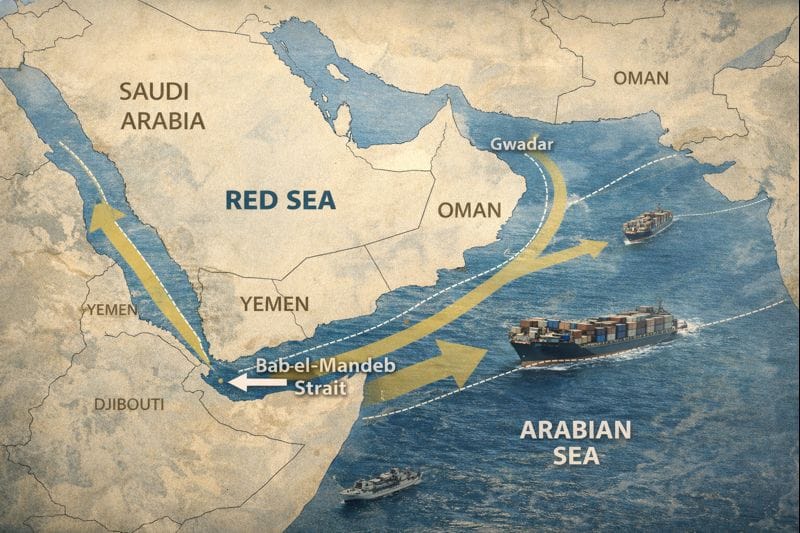
Since 2023 Houthi drone and missile attacks have turned the Red Sea into the most militarized body of water in the world. Commercial traffic through Bab el-Mandeb has dropped by 50% according to Lloyd’s List. This has led to a surge in insurance costs for tankers and ships are rerouting around Africa. In this context Pakistan and Saudi Arabia are working together on naval surveillance and information sharing on maritime threats. For the first time in five years’ Pakistani forces participated in AMAN-25 a multinational exercise in the Arabian Sea with Saudi participation. Sources from Pakistan Naval Headquarters say talks are underway to establish a joint rapid response protocol which would allow limited Pakistani naval deployments under a Saudi led initiative in Red Sea crises. This is not an alliance but a pilot project – a test run for managing regional crises without Washington.
What Makes This Different
This cooperation is not about ideology or sectarian balance It’s transactional but forward-looking, driven by four quiet realities:
Strategic Fatigue in the West: Neither the US nor Europe want to take on new military commitments in the Gulf.
Afghanistan’s Spillover Risks: The Taliban’s shaky control and rising TTP–ISKP activity is pushing Pakistan towards Gulf coordination on counter-radicalization and intelligence sharing.
Economic Survival: For both states, uninterrupted maritime trade equals political stability.
Energy and Transit Integration: Pakistan’s Gwadar Port and Saudi Arabia’s NEOM corridor are part of the same supply chain. Securing them is a shared interest.
In short, this is not Pan-Islamic romanticism. It’s a hard-nosed partnership between two countries that know the cost of chaos.
Internal Debates and Doubts
Not everyone in Islamabad’s policy circles is convinced. Critics within Pakistan’s civilian bureaucracy warn that over-identification with Gulf security could once again subordinate Islamabad’s autonomy. But within the military establishment, the argument is the opposite: engagement buys leverage.
As one retired general put it bluntly:
“It’s better to be inside the security tent shaping the terms than outside reacting to them.”
Riyadh, too, faces its own constraints. The kingdom’s rapprochement with Iran under Chinese mediation is still fragile. Saudi officials say cooperation with Pakistan is “non-directed”, but balancing ties with Tehran and Islamabad will require subtlety.
Options and Next Steps
Regional security planners and think-tanks have proposed several ways to institutionalize the Pakistan–Saudi axis without overexposure:
A Joint Maritime Coordination Center (JMCC) for information-sharing on Red Sea–Arabian Sea threats.
Defence Industrial Partnerships under Pakistan Ordnance Factories and Saudi Military Industries for drone production and maintenance.
Counter-Radicalization Dialogue involving the Organization of Islamic Cooperation (OIC), focusing on digital extremism pipelines from Yemen to Khyber.
All three are being quietly discussed at Track-II levels. Feasibility, experts say, depends less on money and more on political will particularly Riyadh’s readiness to move beyond symbolic gestures.
Why It Matters
If this holds, the Pakistan–Saudi alignment could change how Muslim-majority states manage crises not through external dependency but regional self-help.
It’s not an alliance yet, but it’s something deeper: the re-emergence of trust between two countries that were once patron and client. In a world of no guarantees, that’s the rarest of currencies.
Unpopular Opinion:
While many Western analysts dismiss Pakistan’s cooperation with Saudi Arabia as opportunistic, the reality is more complex. Pakistan is not “aligning”, it is escaping alignment. In a world where the Muslim world’s security is outsourced or ignored, Pakistan is betting that autonomy, however fragile, is still better than managed dependence. This stance underscores Pakistan Saudi strategic autonomy in an increasingly fragmented regional security environment.

Farwa Imtiaz is an independent researcher from the University of Peshawar, Pakistan, specializing in conflict analysis, South Asian geopolitics, and international relations, with a focus on regional security, state behavior, and international diplomacy.